

HOJO ZANMAI
While my current reflections are primarily drawn from Buddhist scriptures, I do not speak from a religious standpoint, but rather from a deep resonance with the symbolic and intuitive truths they contain—truths that seem to echo across spiritual traditions and even scientific frontiers.
Artist Statement – HOJO ZANMAI
HOJO ZANMAI began during the global stillness brought about by the pandemic in 2020.
As the world paused, I turned inward—seeking meaning in a time of uncertainty.
Drawn to ancient texts, I began asking timeless questions:
Where do we come from? Why are we here? What is the universe? What is love?
My studio—a modest, ten-foot-square room—was the size of a hojo,
the simple hut where ancient Japanese thinkers withdrew for spiritual contemplation.
They called such meditative inquiry zanmai.
Immersed in old scriptures, Buddhist thought, and modern cosmology,
I found myself assembling fragments of ancient insight like pieces of a puzzle.
At times, it felt as though a bridge emerged—between past and future,
between the visible and the unseen.
I was deeply moved by the resonances I found between ancient wisdom and contemporary science.
Still, this journey is not something I wish to impose.
Rather, I hope my work may become an invitation—
a gentle prompt for those who may never have asked such questions before.
As an artist, I felt compelled to give form to this experience:
to visualize the unseeable,
to bridge the formless with the visible image.
I call this process Visual Metaphysics—
an art practice that listens to silence and gives shape to the unknown.
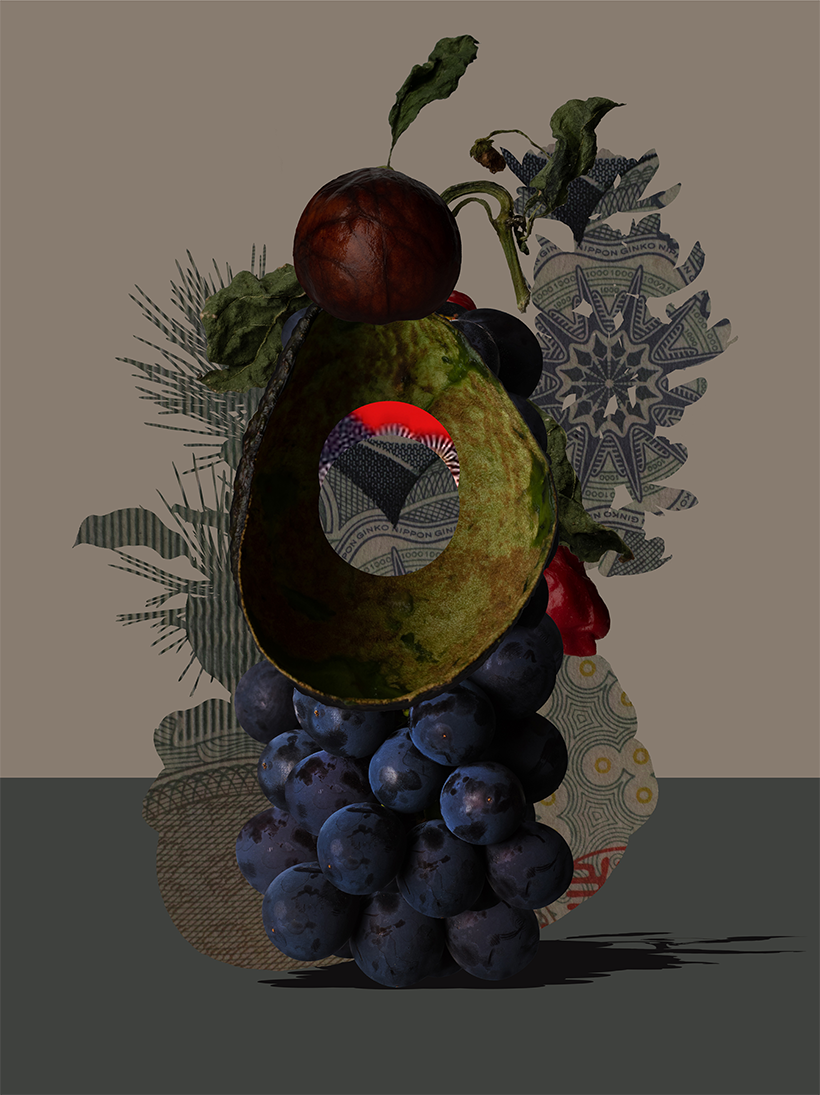
HOJO ZANMAI consists of twelve interrelated works.
Each functions like a fragment of the cosmos,
together forming a mandala-like structure.
It is a visual and layered inquiry into impermanence, perception,
and the vast questions that lie beneath our waking lives.
In this way, HOJO ZANMAI is not merely a collection of images,
but a contemplative space—
a quiet invitation to sense both the outer universe
and the inner cosmos within.
私の現在の思索は、主に仏教の経典に触発されたものですが、特定の宗教的立場から語っているわけではありません。
むしろ、そこに含まれる象徴的かつ直感的な真理に深く共鳴しているのです。
それらは、さまざまな霊的伝統や、時に現代科学の最前線にも響き渡る、普遍的な真理のように感じられます。
アーティスト・ステイトメント – 方丈三昧増田伸也
『方丈三昧』は、2020年のパンデミックによってもたらされた世界的な静寂の中で始まりました。
世界が立ち止まったその時、私は内面に目を向け、不確かな時代の中で意味を求めました。
古代の文献に引き寄せられるようにして、私は時代を超えた問いを投げかけるようになりました。
私たちはどこから来たのか? なぜここにいるのか? 宇宙とは何か? 愛とは何か?
私のアトリエ――一辺三メートルほどの質素な部屋――は、かつて日本の隠者たちが精神的探究のために籠った「方丈」と同じ大きさでした。
彼らはそのような深い瞑想状態を「三昧」と呼びました。
古い経典や仏教思想、現代の宇宙論に没頭する中で、私は古代の断片をパズルのように組み立てる過程に魅了されていきました。
時おり、過去と未来、見えるものと見えないもののあいだに橋がかかるような感覚を覚えました。
古代の智慧と現代科学との間に響きあいを見出したとき、私は深く心を動かされました。
けれどもこの探究の旅を、誰かに押しつけたいとは思っていません。
むしろ私の作品が、こうした問いをまだ抱いたことのない人々に、そっと語りかけるような「きっかけ」となればと願っています。
アーティストとして、私はこの体験にかたちを与えずにはいられませんでした。
見えないものを視覚化し、形なき構造を映像へと架橋すること。
私はこの制作の姿勢を「ヴィジュアル・メタフィジクス(視覚形而上学)」と呼んでいます――
静寂に耳を澄まし、未知なるものにかたちを与えるための芸術実践です。
『方丈三昧』は全12点の作品から成り立っています。
それぞれが宇宙の断片のように繋がり、ひとつの曼荼羅のような構造を形づくっています。
それは、無常や知覚、そして私たちの目覚めた生活の底に広がる大いなる問いへの、視覚的で重層的な探求でもあります。
こうして、『方丈三昧』は単なる作品群ではなく、
思索のための空間——
外なる宇宙と同時に、内なる宇宙を感じるための、静かな招待状なのです。

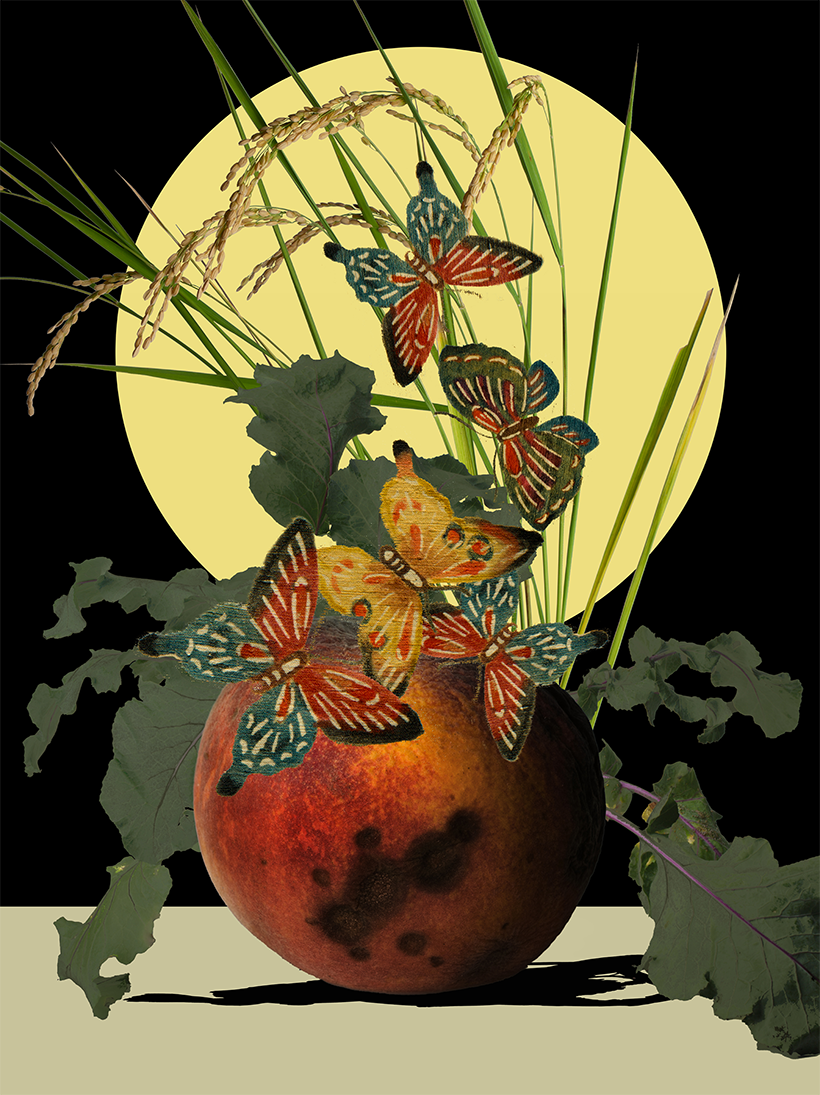
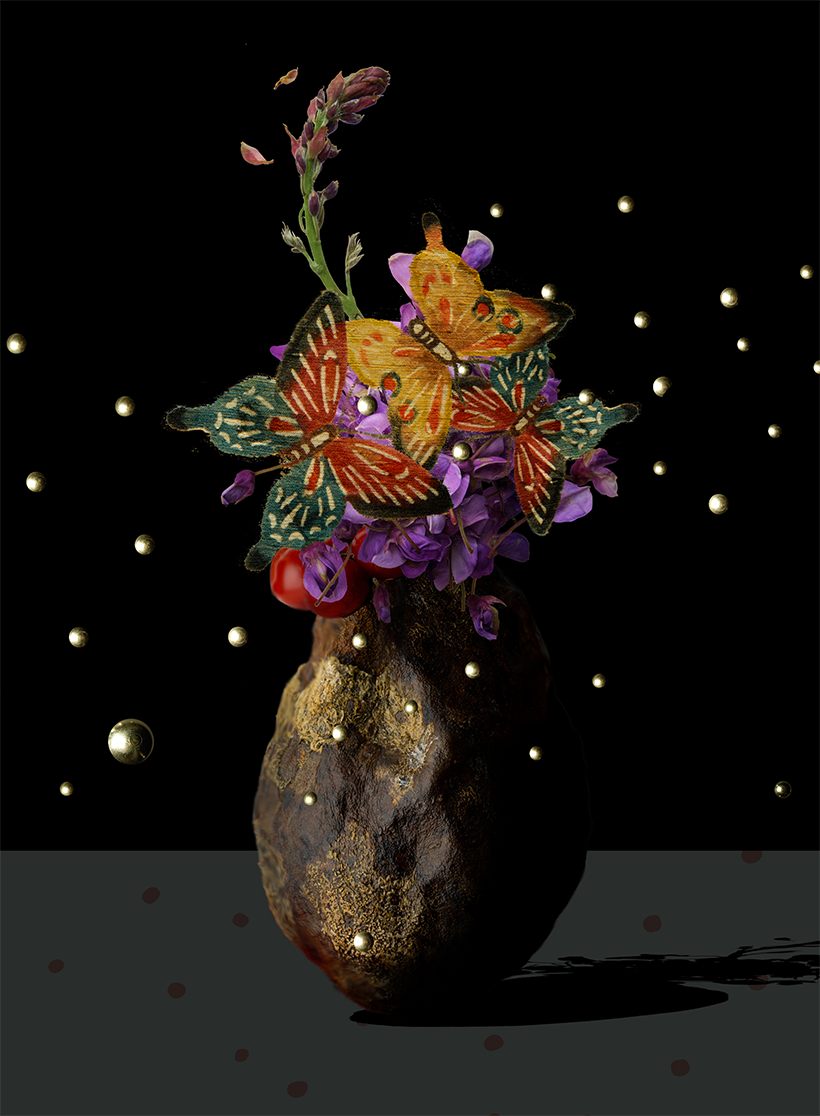


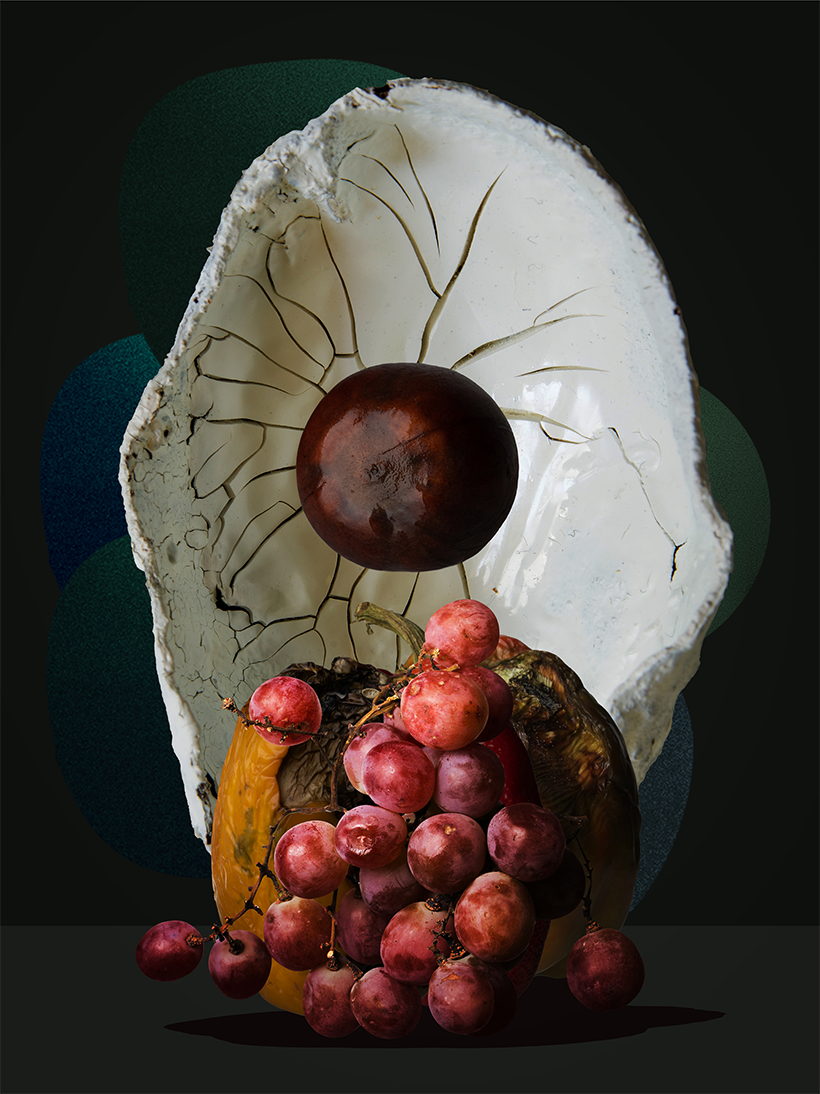

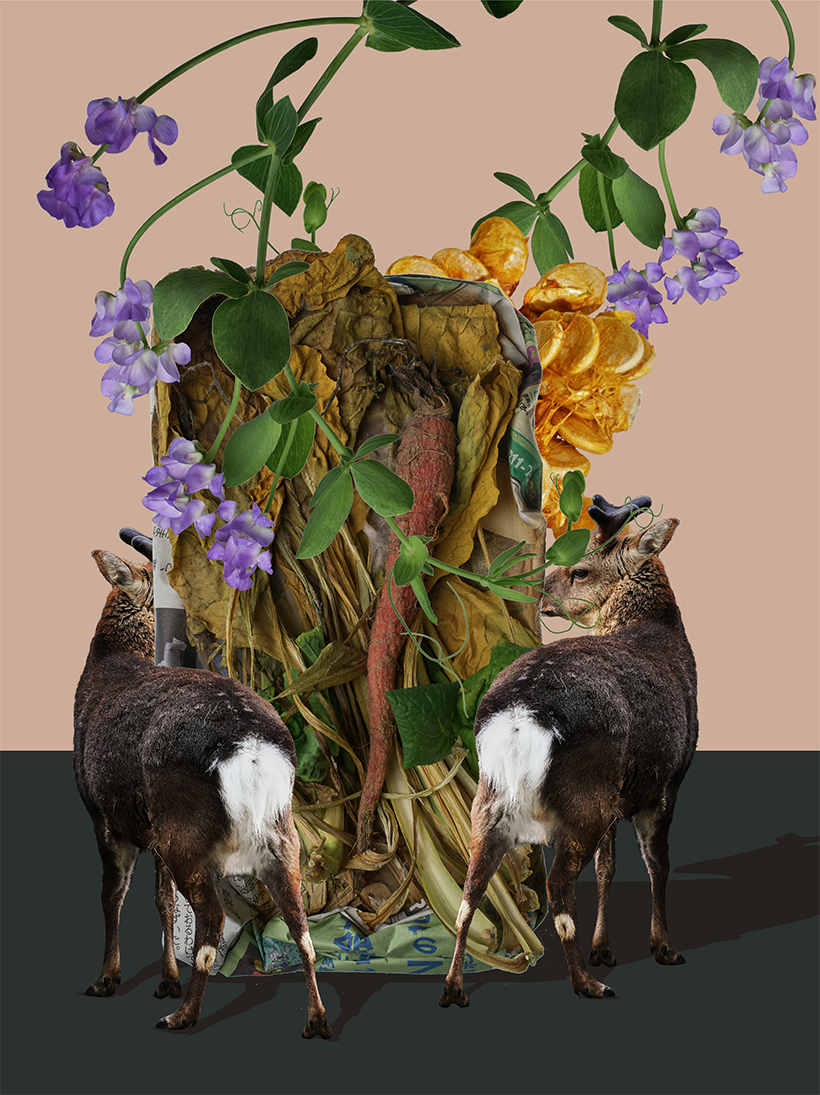


HOJO ZANMAI StatementShinya Masuda
Prologue
In fleeting moments between light and shadow, what do we perceive? As the fabric of our world unfolds, what exists beyond the boundaries of time and space?
HOJO ZANMAI takes its name from Hōjōki, a classical essay by Kamo no Chōmei that contemplates the impermanence of life. However, this work extends beyond a meditation on transience—it is an exploration of the unseen forces that shape existence, inviting the viewer into a space where time, space, and consciousness converge.
At the core of this work lies the concept of Visual Metaphysics—an artistic methodology that bridges the tangible and the intangible, integrating ancient philosophy with modern scientific thought. This approach seeks to explore fundamental metaphysical questions through visual art, weaving together cosmology, Buddhist philosophy, and theoretical physics. By intertwining the words of ancient scriptures with contemporary science, HOJO ZANMAI evokes inquiries that lie dormant within the viewer, encouraging them to perceive beyond the limits of the visible world.
The texture of KYOKUSHI paper, used in this work, reacts to light in a way that reveals new expressions, hinting at different dimensions as it changes over time. This dynamic quality suggests that phenomena are not static but are in constant flux, shaped by the observer’s consciousness and perception.
Where do we come from, and where are we going? Does the universe have a beginning or an end?
HOJO ZANMAI embeds these questions within its depths, quietly speaking to the viewer—leading them beyond what is visible and into the cosmos within themselves.
Main Statement
In Buddhist thought, perception extends beyond mere sight—one must cultivate the ability to comprehend the unseen. This faculty is known as Kanjizairyoku (観自在力), the power to perceive and understand beyond superficial appearances. It is a concept rooted in the recognition that all things are impermanent and interdependent.
HOJO ZANMAI is an exploration of this power through a multilayered visual experience. True perception is not confined to the visible world but extends to the fundamental principles governing existence. The work seeks to uncover the intricate relationships between time, space, and consciousness, creating a bridge between the sensory and the metaphysical.
The inspiration for this work is deeply tied to my personal experiences. My grandmother’s words, “All things are in constant flux,” echo the Buddhist teaching of impermanence. She studied Ryukyu bingata dyeing under Living National Treasure Motohiko Katano. As a child, I watched her meticulously carve stencils, layer colors, and build depth through overlapping patterns—an intricate process that later formed the foundation of my digital collage techniques. Just as bingata derives depth and meaning from layered colors, my work constructs narratives of the unseen by layering images and concepts.
From a scientific perspective, the inquiry within HOJO ZANMAI resonates with Einstein’s theory of relativity, Kant’s epistemology, and the principles of quantum mechanics. These disciplines suggest that reality is not absolute but contingent upon the observer’s perception. Just as light exhibits both particle and wave duality, human perception oscillates between subjective experience and objective recognition. Similarly, in the study of kotodama (the spirit of words), language is believed to bridge the metaphysical and physical worlds, reinforcing the idea that perception is both a sensory and philosophical construct.
HOJO ZANMAI as Visual Metaphysics
This work is a practical embodiment of “Visual Metaphysics.”
It draws upon ancient religious and philosophical texts—such as Buddhist scriptures (primarily The White Lotus of the True Dharma), the Old Testament, and the Vedic literature of Hinduism—as well as the latest cosmological theories developed from classical physics, theoretical physics, and quantum mechanics.
Additionally, it incorporates concepts such as kotodama (the Japanese study of the spiritual power of words) and the scientific insights of cymatics—a field systematized by Swiss physician Hans Jenny that visualizes sound and vibration through physical media.
By recognizing and weaving together points of intersection and resonance across these diverse eras and domains, the work forms its creative foundation.
At the heart of the creative process lie intuitive, formless questions and sensations.
These are transformed into symbolic images and made visible, thus bridging the invisible realms of the spiritual, philosophical, and cosmic with tangible expressions such as photography, composition, and structure.
This process is a journey of weaving threads of thought across dimensions.
“Form Is Emptiness; Emptiness Is Form” and Visual Metaphysics
In Buddhist philosophy, emptiness (空, kū) refers not merely to a void, but to the spiritual, mental, and energetic dimensions of reality—while form (色, shiki) indicates the physical, material world. These dual aspects are not opposites, but expressions of the same essence, echoing the conceptual unity found in Einstein’s equation E = mc², which reveals the equivalence of energy and mass.
In kotodama—the Japanese philosophy of the spirit of language—the pre-verbal structure of the universe is said to be encoded in 17 primal sounds. These correspond to vowels, semi-vowels, and the so-called father tones (父韻, fuin), and are believed to precede and shape creation itself. Consciousness arises first, followed by the birth of emotion. Then comes learning through experience, which matures into wisdom-in-practice (chi), eventually crystallizing into creative intent. These pre-linguistic inner events serve as the dynamic blueprint from which the universe unfolds.
Remarkably, modern particle physics has also identified 17 elementary particles to date. This numerical symmetry, bridging ancient cosmology and cutting-edge science, suggests the presence of a deeper law transcending space, time, and life itself.
Many ancient scriptures—from Buddhist sutras to the Old Testament and Hindu texts—depict creation as beginning with sound or light. Such beginnings may point to resonant frequencies as the primordial force. I find myself resonating with the words and stories (sounds) left by those who came before us. Through them, the invisible world begins to take form, and in turn, the visible world becomes a gateway to the unseen.
“Nothingness contains everything.”
What appears as “nothing” is in fact vacuum, spirit, frequency, and energy in potential form.
The human brain contains the corpus callosum, a bridge connecting the right and left hemispheres. In kotodama, fuin performs a similar role—connecting subject and object. This symbolic function is echoed in sacred texts across cultures, revealing a universal architecture of consciousness and creation.
The Role of Visual Art
In Visual Metaphysics, visual art is not mere ornamentation; it is a medium for transmitting concepts and transforming perception. It serves several key functions:
1. Expansion of Perception
It reveals invisible realms and introduces new perceptual experiences.
2. Provocation of Association
It encourages thought beyond established frameworks, opening pathways into pre-verbal dimensions.
3. Bridging Symbol and Reality
It links disparate domains—myth, religion, science, and philosophy—generating new perspectives.
HOJO ZANMAI 方丈三昧 ステートメント増田伸也
序章
光と影のはざまにある一瞬のゆらぎに、私たちは何を見出すのでしょうか。
世界の織りなす構造の向こうに、時空の境界を越えた何が存在するのでしょうか。
「HOJO ZANMAI(方丈三昧)」というタイトルは、鴨長明の随筆『方丈記』に由来しています。そこでは無常という人生の本質が静かに綴られています。しかし本作は、単なる「無常の美」へのまなざしにとどまりません。目に見えない力が存在をかたちづくる、その領域への探究でもあります。ここでは、時空や意識の枠を超えた空間が広がっています。
この作品の核にあるのは「ヴィジュアル・メタフィジクス(視覚形而上学)」という芸術的手法です。それは、可視と不可視をつなぎ、古代哲学と現代科学を交差させることにより、視覚芸術を通して形而上の問いを探るアプローチです。宇宙論、仏教哲学、理論物理学の知見を交差させ、古代の経典と言葉、現代科学の理論を視覚的に編み上げることで、観る者の内に眠る問いを静かに呼び起こし、見える世界の奥に潜む真理への感受性を促します。
本作に用いた「局紙」は、光の角度や時間の経過によって表情を変えます。まるで異なる次元が立ち現れるように、光によって異なる相を示すこの素材は、あらゆる現象が固定されたものではなく、観る者の意識によって変化し、流動していることを示唆しています。
私たちはどこから来て、どこへ向かうのか。宇宙に始まりや終わりはあるのか。
そのような問いが、この作品の深部に埋め込まれています。
それは、視覚を超えて内なる宇宙へと向かう静かな対話なのです。
仏教において「観る」とは、単に目で見ることにとどまらず、目に見えないものを深く理解する力を意味します。これは「観自在力(かんじざいりょく)」と呼ばれ、すべてのものが無常であり相互に依存しているという認識に基づく力です。
「HOJO ZANMAI」は、この観自在力を視覚芸術によって探求する試みです。真に「観る」とは、可視的な現象に限定されるものではなく、存在の根本原理へと意識を向けることでもあります。本作は、時間・空間・意識の関係性をひもとき、感覚と形而上を結ぶための架け橋を築こうとしています。
その着想の源泉には、私自身の個人的な体験があります。
「この世のすべては、うつろうもの」
幼い頃、祖母がそう口にしていたことが、今も記憶に残っています。祖母は、琉球の紅型を人間国宝・片野元彦氏に師事し、染色を学びました。型紙を彫り、色を幾重にも重ね、柄に奥行きを与えていく。その緻密な重ねの技を幼少期に見て育った私は、やがてそれをデジタルコラージュの技術として昇華させました。紅型が色の重層によって深みを生み出すように、私の作品もまた、不可視の物語をレイヤーとして重ねることで構成されています。
一方、科学的観点からも「HOJO ZANMAI」に内在する問いは、アインシュタインの相対性理論、カントの認識論、そして量子力学の原理と共鳴します。これらの理論は、現実とは客観的に固定されたものではなく、観察者の認識に依存するという考えを提示します。光が粒子であり波でもあるように、人間の知覚もまた、主観と客観のあいだを揺れ動くものです。また、言霊学においては、言葉そのものが物質と精神の世界をつなぐ存在であるとされており、認識の本質が感覚と哲学の両面から成り立っていることを示唆しています。
ヴィジュアル・メタフィジクスとしての HOJO ZANMAI
本作は「ヴィジュアル・メタフィジクス(視覚形而上学)」の実践でもあります。
古代の宗教的・哲学的書物──たとえば仏典(主に『正しい教えの白蓮』)、旧約聖書、ヒンドゥー教のヴェーダ文献など──と、古典物理学・理論物理学・量子力学から発展した最新の宇宙論、さらに日本に古くから伝わる「言霊学」といった概念、そしてスイスの生理学者ハンス・ジェニーによって体系化された「サイマティクス(音や波動を媒質上に可視化する研究)」などの知見を参照しながら、これら異なる時代と領域の間に見出される共通点や交差点を軸に、創作の基盤を形成しています。
創作の起点には、形を持たない直観的な問いや感覚があります。
それらを象徴的なイメージへと変換し、可視化することで、目に見えない精神的・哲学的・宇宙的な領域と、写真や構造といった具象的表現との間に橋を架けていきます。
このプロセスは、次元を越えて思考の糸を編み上げていく旅でもあります。
「色即是空・空即是色」と視覚形而上学
仏教哲学において「空(くう)」とは、単なる虚無ではなく、霊的・精神的・エネルギー的な次元のことを指し、「色(しき)」は物質的・形ある世界を意味します。これらは対立するものではなく、同じ本質の異なる現れであり、アインシュタインの「E = mc²」(エネルギーと質量の等価性)という概念とも共鳴しています。 日本の言霊思想では、宇宙創造以前の前言語的構造が、17の根源音に集約されているとされます。これらは、母音・半母音、そして「父韻(ふいん)」と呼ばれる音から成り、宇宙の創造そのものを先導するものとされています。最初に「意識」が芽生え、次に「感情」が生まれます。そして「経験による学び」が訪れ、それがやがて「叡智(実践知)」となり、最終的には「創造の意志」として結実していく――こうした未だ言葉にならない内的プロセスが、宇宙の展開を導いていくのです。
驚くべきことに、現代の素粒子物理学でも、現在までに17種類の基本粒子が発見されています。この数の一致は、単なる偶然とは思えず、時空や生命を超えた深い法則の存在を感じさせます。
多くの古代の聖典――仏典、旧約聖書、ヒンドゥー教の経典――は、創造の始まりを「音」または「光」として描いています。これらは、宇宙の根源にある共鳴周波数の存在を示唆しているのではないでしょうか。私自身、先人たちが遺した言葉や物語(音)に深く共鳴し、そこから「見えない世界」が「見える世界」へと形を持ちはじめ、また逆に、「見える世界」も「見えない世界」へとつながっていくことを感じるようになりました。
「何もないとは、すべてがあること。」
「何もない」とは、実は真空であり、精神であり、周波数であり、エネルギーで満ちている潜在的な状態なのです。
人間の脳には、右脳と左脳をつなぐ「脳梁(コーラス・カロサム)」という構造があります。同様に、言霊における「父韻」もまた、主体と客体を結びつける役割を果たします。このような象徴的な構造は、聖書を含む多くの聖典においても共通して見られる、普遍的な意識と創造のアーキテクチャを示しています。
視覚芸術の役割
視覚形而上学におけるアートは、装飾ではありません。
それは、概念を伝達し、知覚を変容させるための媒体です。
以下のような役割を担っています:
1.知覚の拡張
可視を超えた領域を顕現させ、新たな知覚の地平を切り開く。
2.連想の誘発
既存の思考の枠組みを超え、前言語的領域への通路をひらく。
3.象徴と現実の架橋
神話、宗教、科学、哲学といった異なる領域を結び、新たな視点を生む。
視覚形而上学の可能性
ヴィジュアル・メタフィジクスは、形而上学と芸術の交差点において、知の新たな地平を開く可能性を秘めています。宇宙の構造、生と死、言語の起源、時間と空間の本質――そうした普遍的テーマに触れるための入口となるのです。
「HOJO ZANMAI」は、その試みを具現化した一つの答えです。
それは、視覚という手がかりから世界の奥層へと入り込む行為でもあります。
本作が、観る者にとって「知覚とは何か」「現実とは何か」を問い直すための静かな空間となることを願っています。
見るという行為を通して、私たちは知覚を超えた問いに触れることができる。
その旅に、終わりはありません。
しかしその旅路にこそ、私たちの「存在すること」の本質があるのかもしれません。
